
Cross the Guadalquivir into Triana and discover the fiercely individual neighbourhood whose flamenco, food, history and everyday rhythm reveal a very different side of Seville.
My first impression of Seville wasn’t exactly the most romantic. Arriving at the bus station after a long journey, tired, hungry and carrying my backpack, there wasn’t much about those first few streets that immediately suggested I was about to fall head over heels for Andalucía’s capital. But first impressions can be deceptive, and despite the frankly uninspired and borderline dilapidated bus station, it didn’t take Seville very long to change my mind.
Once I had dumped my pack and started exploring properly, I fell in love with the city almost immediately, and not just because it was a world apart from the deplorable resorts serving all day English breakfasts to drunken tourists on the coast. Seville is simply gorgeous. Orange trees line beautiful old streets, grand plazas open up unexpectedly between tightly packed buildings, hidden courtyards tempt you to peer through open doorways and magnificent architecture seems to appear around every corner. Add the almost constant temptation of tapas and coffee and frankly I didn’t stand much of a chance.
I spent days wandering around the city with only the vaguest idea of where I was going, happily getting lost in Santa Cruz, exploring the Real Alcázar, staring up at the Cathedral and Giralda and finding increasingly flimsy excuses to stop at yet another tapas bar. It would have been rude not to, after all. Seville has some truly extraordinary sights, and I loved all of them, but strangely enough it wasn’t any of the grand palaces, enormous churches or famous attractions that really captured my heart. That happened when I crossed the Guadalquivir into Triana.
I hadn’t actually set out to discover Triana at all. I found it completely by accident. I was wandering along the river one day, saw the bridge and crossed it on little more than a whim, with no real idea of what was waiting for me on the other side. But that in and of itself is part of its understated charm. Triana doesn’t announce itself, it doesn’t have the pomp or regalia of some of the more popular attractions, but what it does have is an abundance of life and culture hidden just beneath the surface.
And the more I wandered, the more that character began to reveal itself. Triana has historically been a working-class neighbourhood, home to generations of sailors, dockworkers, potters and ceramic makers, alongside a significant Roma community whose influence helped make the barrio one of the great centres in the cultural development of flamenco. Maybe my own gypsy heritage had something to do with the strange sense of familiarity and connection I felt almost immediately. I don’t know, but there was something about Triana that felt instinctively comfortable to me.
Triana’s history hasn’t been polished away or confined to museums either; it is deeply embedded in the soul of the place and woven through everyday life. You can see it in the ceramics covering its buildings, hear it in the music spilling out of bars and feel it in the fierce sense of local identity that Triana has retained despite sitting just across the river from the heart of Seville.
Of course, I knew very little of that when I first wandered across the bridge, and in many ways that made discovering it even better. There was no itinerary, no list of attractions I was trying to tick off and no expectation of what I was supposed to find. I was simply following my feet, stopping for food whenever I felt like it and seeing where the streets took me. Somewhere along the way, without me really noticing it happen, Triana completely seduced me.
Discovering Triana
With no real plan for what I was supposed to be doing in Triana, I simply started wandering, and one of the first places I stumbled into was the Mercado de Triana. Sitting immediately beside the bridge, the market is packed with fruit and vegetables, meat, fish, cheese and small bars and food stalls, with locals weaving between them doing their shopping while everyone behind the counters seems to be talking at once.
Naturally, I decided this was an excellent opportunity to practise my extremely bad Spanish. My attempts to buy some fruit earned a few friendly laughs, a lot of confusion and eventually some linguistic assistance from vendors whose English was considerably better than my non-existent Spanish. I may not have done much for Anglo-Spanish relations that morning, but at least I tried! And I did get a free apple for the attempt from a generous stall owner, so that’s a bonus!
What I hadn’t realised while happily butchering the Spanish language above ground was that the market was sitting directly over the remains of the Castillo de San Jorge, the medieval fortress that later became the headquarters of the Spanish Inquisition in Seville. It’s always been a part of history that has fascinated me, so one minute I was wandering between food stalls pointing hopefully at fruit, and the next I was exploring archaeological remains beneath the market with several centuries of dark history underneath my feet.
Back above ground, that history carried on through the surrounding streets. Nearby I found the wonderfully ominous Callejón de la Inquisición, a narrow passage associated with the castle and traditionally linked with prisoners being taken to and from the tribunal, or kangaroo court for failing to fall in line with the state’s point of view, however you want to look at it. Nothing here seemed neatly separated into an attraction, a museum and then somewhere to eat; centuries of history were simply woven into streets where people were shopping, drinking, laughing and getting on with their day.
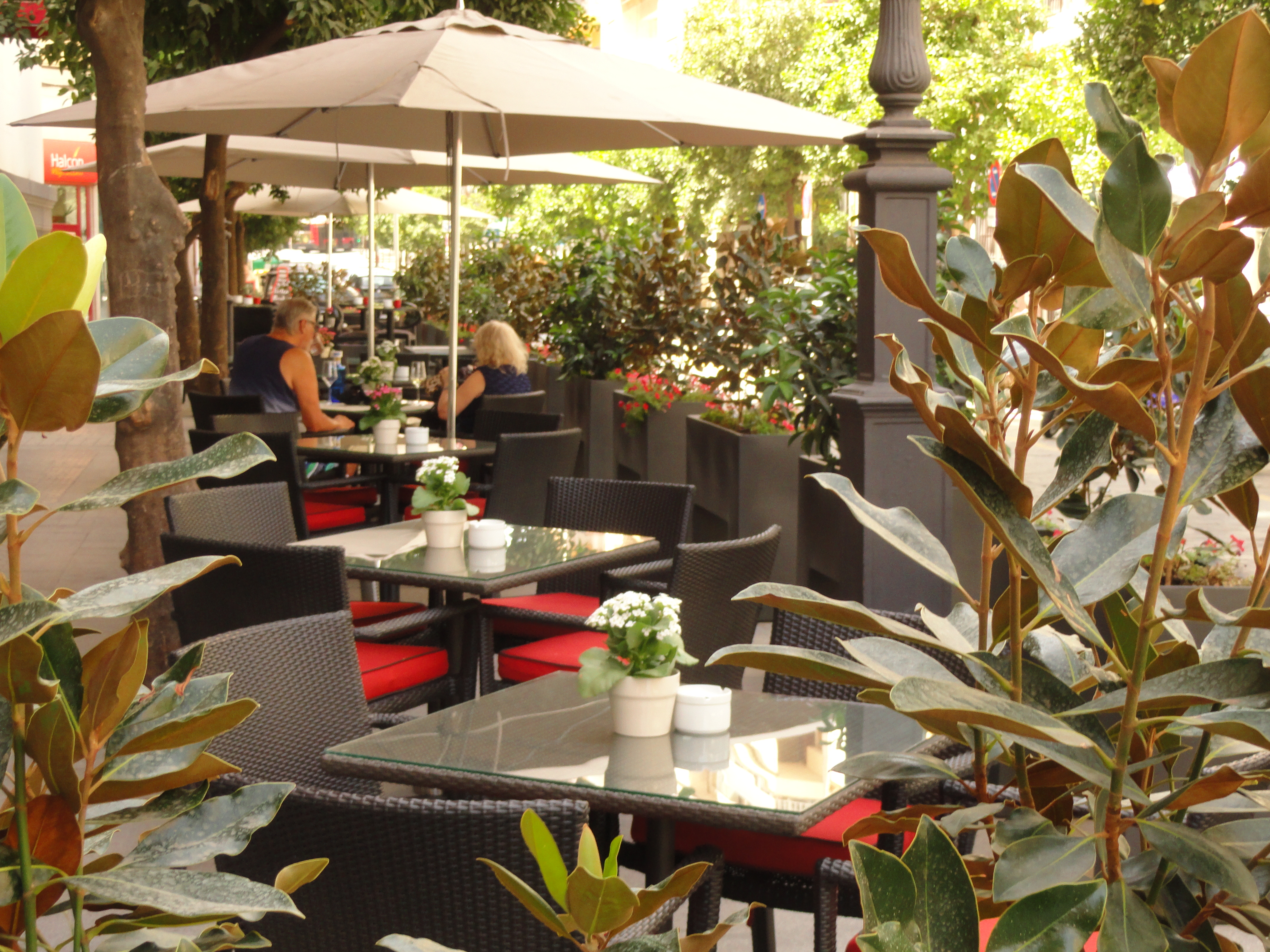
That same everyday life spills out along Calle Betis, where the colourful façades of Triana line the Guadalquivir and bars and restaurants look back across the water towards central Seville. This was exactly my kind of place. Tapas within reach, a cold drink on the table and an endless procession of people to watch while boats drifted along the river and the Cathedral and rooftops of Seville rose above the opposite bank.
Whatever vague plans I might have had disappeared somewhere between the tapas and the view. There was nowhere else I particularly needed to be, and sitting there watching Triana carry on around me felt like as good a way as any to spend an afternoon.
The Flamenco Spirit
The afternoon had settled into that wonderfully unhurried rhythm that Andalucía does so well. I had tapas in front of me, a drink within reach and absolutely no pressing reason to be anywhere else, while conversations and laughter drifted between the tables around me and Triana simply carried on with its day.
Somewhere amongst all that noise I became aware of a guitar. An older man with an impressive handlebar moustache was sitting outside one of the bars playing flamenco, not on a stage or as part of an organised performance, but seemingly for the simple pleasure of playing. People sitting with their coffee and tapas nearby began paying attention, a few stopped to listen, and before long a young woman stepped forward and started to dance.
I’d already seen flamenco performed on stage in Seville, and had been blown away by the skill and intensity of it. This was something completely different, spontaneous and improvised, unfolding naturally in the middle of an ordinary afternoon.
There was no costume, no stage lighting and none of the carefully packaged spectacle you might expect from a formal flamenco show. Just an old man with a guitar, a young woman dancing on the pavement and a loose circle of people who had stopped whatever they were doing to watch.
She was incredible. Her feet moved at a blistering pace, pounding out an impossibly fast rhythm as the guitarist responded to her movements and the growing crowd clapped along. The speed, control and precision were astonishing, and I couldn’t take my eyes off her. But after she started stamping the floor with so much force my old Karate Sensei would have been impressed, the street really took off with most of the patrons cheering and shouting, some of them even joining in! Real Flamenco can get really rowdy!
And perhaps that was the part I hadn’t understood until I saw it for myself. Flamenco in Triana isn’t simply something performed on a stage; its roots lie in the homes, courtyards, taverns, gatherings and communities where people sang, played, danced, clapped and joined in. What looked to me like an impromptu performance was also an expression of a living tradition that has been part of this neighbourhood for generations.
That explained why nobody seemed to be treating any of it as particularly extraordinary. People watched, clapped and enjoyed it, and when it was over the tables returned to their conversations, drinks were picked back up and the neighbourhood carried on around us. For me it had been this amazing, unexpected cultural experience; for everyone else it seemed to be just another afternoon in Triana.
That was what stayed with me. I hadn’t booked a flamenco show or gone searching for some carefully curated cultural experience. I had crossed a bridge on a whim, wandered around a market, massacred the Spanish language, explored the remains of the Inquisition, eaten far too many tapas and happened to be sitting there when a guitarist started playing and a young woman decided to dance.
It was spontaneous, effortless and completely unexpected, and for those few minutes I wasn’t being shown the culture of Triana. I was simply lucky enough to see it happening around me.
I crossed back over the Guadalquivir later that day having fallen completely in love with Triana. Not because of any single attraction, although there is plenty of history to discover, and not because I had uncovered some secret corner of Seville that nobody else knew about. I had simply wandered across a bridge on a whim and found a neighbourhood where history, food, music and everyday life seemed to exist effortlessly alongside one another. That is what backpacking is all about!
The Real Alcázar was magnificent. The Cathedral and Giralda were extraordinary. Seville’s grand plazas, palaces and gardens absolutely deserve every bit of attention they receive, and I would return to explore them all again in a heartbeat. But when I think back to that first trip to Seville, it isn’t any of those things that I remember most vividly.
I remember a free apple from a market trader after massacring his language. I remember discovering the remains of the Spanish Inquisition underneath an ordinary food market, eating tapas beside the Guadalquivir and watching an old man with a magnificent moustache pick up his guitar while a young woman stamped out a furious flamenco rhythm on the pavement.
None of it was planned. None of it was something I had crossed off a list. It was simply an afternoon spent wandering through Triana and allowing the neighbourhood to reveal itself as I went.
And perhaps that is why, after all these years and all the extraordinary places I’ve seen in Seville, Triana is still the part of the city that stays with me most.

Michael Huxley
Michael Huxley is the founder of Bemused Backpacker, a travel writer, published author, international speaker and former nurse who has spent more than twenty-five years travelling independently through over 150 countries. He helps readers travel with more confidence, safety and perspective.
Spain
Discover the real Spain beyond the resorts, from extraordinary cities and regional cultures to wild landscapes, incredible food and unforgettable experiences.

Culture Shock In Spain: Living La Buena Vida
Discover what culture shock in Spain really feels like, from late nights and even later dinners to slowing down, letting go and learning to live la buena vida.

What Are The Best Things To Do In Spain?
Discover the best things to do in Spain, combining the country’s unmissable highlights with extraordinary landscapes, cultural experiences and lesser-known adventures far beyond the usual tourist trail.

What Are The Best Things To Do In Seville, Spain?
Discover the best things to do in Seville, from the Alcázar and magnificent historic centre to flamenco, tapas, Triana and the experiences that reveal the city’s real character.

Losing My Fear Of Speaking Spanish
After returning to Seville, I finally discovered what it feels like to stop rehearsing Spanish and start actually speaking it.

26 responses to “The Seductive Soul Of Triana, Seville”
This sounds like an amazing trip, I love finding the real heart of any city I go to rather than just the touristy places.
I know exactly what you mean. Me too. 🙂
Looks like a beautiful village! I’ll definitely add it to the list when we plan our trip to Spain!
It really is Jen! Let me know if you have any questions 🙂
I’ve heard this about parts of Spain that when you are on a budget you can basically go without paying for meals because of all the free tapas, is that true?
Kind of, but you have to remember that not all places offer free tapas either, some cities like Seville, you have to pay. In the places that do offer you free tapas you can fill up quite easily on them and I did skip lunch once or twice because I had eaten a fair amount of tapas, but you still have to pay for drinks, and it isn’t a replacement for a good main meal.
I love your photography, very beautiful. I wish to go there one day.
Aw thank you very much! Well there’s nothing stopping you, why not give Nomad Spain a look, I’m sure they can help you. 🙂
Ah I have a LOT of fond memories of Seville, and all the tapas!This brought back a lot of fond memories. Great article.
Thank you!Hope it inspired you to want to go back?
Definitely! There’s a lot of Spain (and Europe) I have still yet to see. I’ve just checked out the Nomad Spain company you went with, and they seem pretty good. They really just sort out the transport and accomodationa and then leave you to it? Because that sounds perfect to me! Like a lazy backpacking trip!
Haha, that is pretty much spot on! Yep, they are a great company to work with and they sort the basic logistics out for you and leave you to explore on your own terms, with advice where and when needed. For anyone who has never travelled independently before and is a little nervous about doing it, using these guys is a great idea.
What a great post, its so nice to read about the real Spain, not just the overtouristy parts.
Thank you, I know exactly what you mean.
I loved reading this! So well written. Xo
Thank you very much. 🙂
Nice place to travel.
It really is. 🙂
I’ve travelled to Spain and Andalucia quite a lot in recent years but for some reason have never yet been to Seville. I really must put it on the list!
You should, it is an amazing place!
Hi Mike!
Wow, you wrote such a great post about Seville! We love it! You caught the essence of Seville, for example in Triana. Just by crossing the river you can discover this amazing neighbourhood.
Thanks a lot!!
Thanks for reading, I’m glad you enjoyed it. 🙂
I wish more people would take the time to look into any given city or country a little more deeply like this. I love this post and will definitely make Triana a must see stop when I visit Spain next year!
I do too, and enjoy Triana, it’s an amazing place.
Wow, I love finding hidden spots like these myself. I mean I hate using the term ‘off the beaten track’, I think ‘away from the package tourists’ should do just fine. Trianna sounds like an amazing part of Seville to get lost in
Haha, I love that definition!