
Minneriya National Park: A Wildlife Tourism Case Study
An actionable case study to identify what works, what can be improved and what lessons wildlife operators can apply to strengthen welfare, conservation and responsible visitor management at their facility.
About This Wildlife Tourism Case Study
This case study examines a real-world wildlife tourism experience through the lens of animal welfare, conservation and responsible tourism. Using recognised best-practice principles, it assesses how effectively the experience balances visitor expectations with the needs of wildlife, identifies strengths and areas for improvement, and highlights lessons that travellers, operators and the wider tourism industry can learn from.
The Attraction
Minneriya National Park is one of Sri Lanka’s most famous wildlife destinations and is particularly known for the seasonal gathering of wild Asian elephants around the Minneriya Tank. This event is often described as one of the great wildlife spectacles of Asia, attracting large numbers of visitors hoping to see elephants in significant numbers.
On paper, Minneriya should sit close to the ethical end of the elephant tourism spectrum. The elephants are wild, free-ranging and observed in a protected area. There is no riding, no performance, no bathing, no feeding and no direct contact. Yet Minneriya also demonstrates one of the most important lessons in ethical wildlife tourism: seeing animals in the wild is not automatically ethical if the tourism model surrounding them is poorly managed.
The Ethical Tourism Standard
Responsible wildlife viewing should allow animals to continue natural behaviour with minimal disturbance. ABTA’s animal welfare guidance recognises that animal attractions and wildlife experiences must be managed carefully and sets out good practice, discouraged practice and unacceptable practice for tourism suppliers. In the context of elephant tourism, ABTA highlights respectful distance, natural habitat access and freedom from cruelty or punishment as key principles.
The Five Freedoms are also relevant here, especially freedom from fear and distress and freedom to express normal behaviour. Even wild elephants can experience compromised welfare if tourism activity disrupts feeding, movement, social interaction or rest. A safari that crowds elephants, blocks their movement or pressures them for photographs may not involve captivity, but it can still interfere with welfare.
The Experience
Minneriya’s greatest strength is also its greatest vulnerability: it is spectacular. The chance to see large numbers of elephants in one place is exactly what makes it so attractive to visitors, guides, photographers and tour operators. But when demand is high and management does not keep pace, spectacle can quickly turn into pressure.
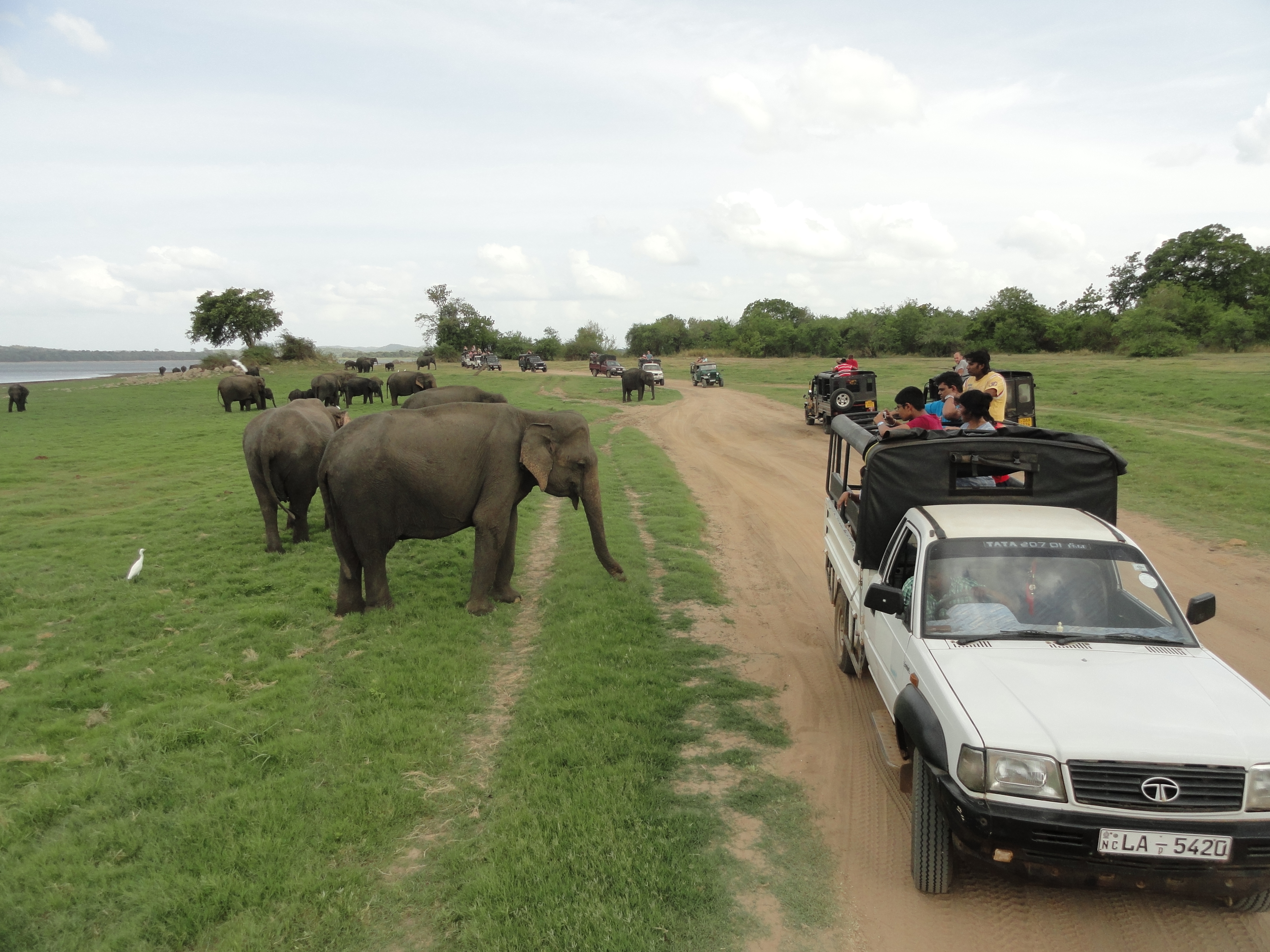
In the original Sri Lanka article, Minneriya was presented as the negative contrast to Gal Oya. The park itself was described as beautiful and important, but the experience was far more crowded, tourist-heavy and less responsible. The issue was not the elephants or the landscape. The issue was the way tourism gathered around them.
This is the central lesson Minneriya offers. Wild elephants can still be affected by tourism when too many vehicles converge on sightings, when guides compete for position, when tourists demand closer photographs and when visitor satisfaction becomes more important than the animals’ ability to behave naturally.
Assessment Against Ethical Tourism Principles
Animal Welfare
Minneriya avoids the most obvious forms of unethical elephant tourism because it does not involve captivity, riding, performances or direct interaction. However, welfare is not only about avoiding the worst practices. It is also about minimising disturbance.
If safari vehicles crowd elephants, block movement routes or remain too close for too long, the experience moves away from responsible observation and towards intrusion. This is particularly concerning for family groups, calves or elephants attempting to feed, move or access water.
Conservation Impact
Minneriya has significant conservation value because it protects habitat and supports one of Sri Lanka’s most important wild elephant spectacles. Responsible tourism revenue can help justify protected areas and contribute to local economies. However, conservation value can be undermined if the tourism model places increasing pressure on the animals or damages the visitor experience through overcrowding.
The IUCN Asian Elephant Specialist Group identifies habitat protection, connectivity and human-elephant conflict as central conservation challenges for Asian elephants. Protected areas such as Minneriya matter enormously within that wider landscape, but tourism must support those conservation goals rather than compromise them.
Visitor Management
Visitor management is the critical issue at Minneriya. A high-profile wildlife spectacle requires clear rules, active enforcement and guide standards that prioritise animal welfare over tourist demand. Without limits on vehicle numbers, approach distances and time spent at sightings, even a wild elephant experience can become stressful and intrusive.
This is where Minneriya becomes such an important case study for the wider wildlife tourism industry. Popularity is not the enemy of ethical tourism, but unmanaged popularity can become one.
Education And Interpretation
Minneriya has enormous educational potential. Visitors are witnessing one of Asia’s most significant elephant gatherings, and that should be used to teach them about elephant behaviour, habitat, seasonal movement, conservation pressures and responsible wildlife viewing.
However, education must be embedded into the experience. If the focus is only on seeing elephants and taking photographs, a major opportunity is lost. Guides should be trained not only to find wildlife but also to manage visitor expectations and explain why distance, patience and restraint matter.
Community And Economic Benefit
Minneriya clearly has economic value for local tourism businesses, guides, drivers and surrounding communities. That matters. Ethical wildlife tourism should provide real benefits for people as well as wildlife.
The challenge is ensuring that economic benefit does not become dependent on increasingly intrusive wildlife encounters. A sustainable tourism model should reward responsible operators, not those who get closest, move fastest or pressure animals most aggressively.
Key Strengths
Minneriya’s greatest strength is its conservation potential. It offers visitors a rare opportunity to observe wild Asian elephants in significant numbers within a protected landscape, without the direct exploitation associated with captive elephant tourism. Unlike riding camps, performances or interaction-based attractions, the elephants remain free-ranging and able to maintain their natural social structures, movement patterns and behaviours.
At its best, Minneriya demonstrates why habitat protection remains one of the most important conservation tools available for elephants. Experiences such as the annual gathering allow visitors to witness not only the animals themselves, but also the ecological importance of the landscapes that sustain them. This can be a powerful educational tool, helping travellers understand the relationship between wildlife conservation, habitat protection and the long-term survival of elephant populations.
Perhaps most importantly, the experience has the potential to foster a genuine appreciation for elephants as wild animals rather than tourist attractions. When managed responsibly, wildlife tourism can inspire support for conservation, generate economic value from protecting natural habitats and reinforce the argument that elephants are worth far more alive, wild and free than they ever are in captivity. In this respect, Minneriya represents exactly the kind of wildlife experience that responsible tourism should be encouraging.
Areas For Improvement
The challenges observed at Minneriya are not unique, nor are they unusual within successful wildlife tourism destinations. The park’s popularity reflects the exceptional wildlife experience it offers, but popularity inevitably creates management pressures that require careful oversight if conservation objectives, animal welfare and visitor experience are to remain aligned over the long term.
Importantly, the issues identified are best understood as visitor management challenges rather than fundamental flaws in the attraction itself. Minneriya remains one of Asia’s most important elephant viewing destinations, and its conservation value is significant. The objective should not be to reduce access to wildlife, but to ensure that access is managed in a way that protects both the elephants and the long-term sustainability of the experience.
One of the most immediate opportunities for improvement lies in the management of vehicle density around elephant sightings. During peak periods it is not uncommon for large numbers of safari vehicles to converge on a single group of elephants, particularly when calves or larger herds are present. While each individual vehicle may appear harmless, the cumulative effect can create substantial pressure on the animals and alter their natural behaviour. This approach sits uneasily alongside internationally recognised wildlife tourism standards, including ABTA’s Animal Welfare Guidelines, which emphasise minimising disturbance and allowing wildlife to behave naturally without interference from tourism activities. Establishing limits on the number of vehicles permitted around a sighting at any one time, supported by active ranger enforcement, would significantly reduce disturbance while simultaneously improving the quality of the visitor experience.
Clearer approach-distance protocols would also strengthen welfare outcomes. Responsible wildlife tourism depends on allowing animals to dictate the terms of an encounter rather than encouraging ever-closer access in pursuit of photographs. ABTA guidance, alongside broader responsible wildlife tourism principles, stresses the importance of maintaining appropriate viewing distances and avoiding situations where wildlife alters its behaviour because of human presence. During busy periods at Minneriya, elephants can find themselves effectively surrounded by vehicles or repeatedly approached as guides compete for viewing positions. Formal minimum viewing distances, particularly around family groups and calves, would help ensure that welfare remains the priority while creating clearer expectations for both guides and visitors.
Visitor flow management should also be considered. One of the key drivers of pressure at Minneriya is the concentration of large numbers of vehicles in relatively small areas during peak viewing periods. Timed entry systems, designated viewing zones and rotational access to key wildlife areas are all established visitor management tools used successfully in protected areas around the world. Such measures would help distribute visitor pressure more evenly throughout the park while reducing congestion around individual elephant sightings.
Guide training represents another significant opportunity. Guides operate at the interface between wildlife and visitor expectations, and their decisions play a critical role in shaping both welfare outcomes and visitor experiences. Enhanced training in elephant behaviour, welfare indicators, responsible viewing practices and interpretation skills would help shift the emphasis from proximity to understanding. A guide who can explain why elephants are behaving in a certain way, interpret social interactions within a herd or identify signs of stress can often provide a far richer experience than one who simply gets visitors closer to the animals.
Visitor education should form part of this strategy. Many wildlife tourism challenges originate not with guides or operators, but with visitor expectations. Tourists frequently arrive expecting close encounters, dramatic wildlife moments and exceptional photographic opportunities because that is how wildlife tourism is often marketed. ABTA, the Global Sustainable Tourism Council and other responsible tourism organisations all emphasise the importance of managing visitor expectations before the experience begins. Clear pre-safari briefings explaining responsible wildlife viewing principles, acceptable viewing distances and the reasons behind visitor management measures would help align visitor expectations with conservation objectives and reduce pressure on guides to prioritise spectacle over welfare.
Photography culture deserves particular attention. Modern wildlife tourism is increasingly shaped by social media, where close encounters and dramatic images often receive the greatest visibility. This can create incentives for both visitors and operators to prioritise proximity over responsible wildlife viewing. Park authorities and tourism operators should actively promote responsible wildlife photography principles that celebrate natural behaviour, respectful observation and authentic wildlife experiences rather than rewarding the closest possible image. The most ethical wildlife encounters are rarely defined by distance. They are defined by how little the animal’s behaviour changes because of our presence.
From a welfare perspective, many of these recommendations align closely with the internationally recognised Five Freedoms framework, particularly the freedom to express natural behaviour and the freedom from fear and distress. While originally developed for managed animal care environments, these principles remain highly relevant to wildlife tourism. Any tourism activity that restricts movement, interrupts feeding, influences social behaviour or creates unnecessary stress risks compromising animal welfare, regardless of whether the animals involved are wild or captive. The objective should therefore be to create conditions in which elephants can continue behaving as naturally as possible despite the presence of tourism.
Finally, ongoing monitoring should underpin any future management strategy. Effective wildlife management depends on evidence. Collecting data on visitor numbers, vehicle distribution, elephant behaviour, congestion hotspots and welfare indicators would allow management decisions to be informed by observation rather than anecdote. Such monitoring would also provide a mechanism for evaluating the effectiveness of any interventions and adapting management approaches over time.
Ultimately, none of these recommendations are particularly radical. They are largely consistent with the direction of travel already established by organisations such as ABTA, the Global Sustainable Tourism Council, World Animal Protection and wider responsible wildlife tourism best practice. The challenge for Minneriya is therefore not identifying the standards it should aspire to, but implementing them consistently in a destination where popularity and commercial pressures can sometimes conflict with welfare and conservation objectives.
The long-term success of Minneriya depends upon maintaining the balance between tourism and conservation. Protecting elephant welfare, preserving natural behaviour and delivering a high-quality visitor experience should not be viewed as competing objectives. In well-managed wildlife tourism destinations, they are mutually reinforcing outcomes. Minneriya already possesses the wildlife, conservation value and international profile required to become a leading example of responsible elephant tourism. The opportunity now is to ensure that management standards evolve at the same pace as visitor demand.
Lessons For The Wildlife Tourism Industry
Minneriya shows how quickly good wildlife tourism can become problematic when demand is not carefully managed. The elephants are wild, the setting is natural and the conservation value is real, but those strengths do not remove the need for responsible tourism standards.
The wider industry lesson is that ethical wildlife tourism is not defined only by the absence of captivity. It is defined by behaviour, management and impact. If tourism changes how animals move, feed, rest or socialise, then welfare is part of the conversation.
What Travellers Can Learn
Travellers should not assume that every safari is ethical simply because the animals are wild. Before booking, they should ask how operators manage distance, vehicle numbers and wildlife disturbance. They should choose guides who prioritise responsible viewing over close photographs and should be willing to accept that the best wildlife encounters are often quieter, slower and less intrusive than expected.
A good elephant safari should leave the elephants in control of the encounter. If the animals are surrounded, followed or pressured, the experience has moved too far towards the tourist’s needs and away from the elephant’s welfare.
Final Assessment
Minneriya National Park remains one of Sri Lanka’s most important wild elephant tourism experiences, but it also demonstrates the risks of unmanaged popularity. Its conservation value is significant, and seeing elephants in the wild is generally far preferable to captive elephant tourism. However, responsible wildlife viewing requires more than wild animals in a protected area.
Minneriya’s lesson is not that elephant safaris are unethical. It is that even good wildlife tourism needs strong standards. Without careful visitor management, education and enforcement, the desire to see elephants can begin to compromise the very wildness that makes the experience valuable in the first place.
Learn To Evaluate Wildlife Tourism More Critically
Wildlife tourism is rarely as simple as good or bad. Explore the Bemused Backpacker Code of Meaningful Travel to learn how to assess wildlife experiences through the lens of animal welfare, conservation and responsible tourism.


 Bemused Backpacker